
Last Updated on July 29, 2026 by Admin
Vertical mobility has transitioned from a structural luxury to a core utility in modern urban design. Whether you are managing a multi-story residential housing complex in Pune or overseeing a high-traffic industrial facility, the continuous operation of your elevator systems is critical. However, building owners and facility managers often face a common dilemma: how to properly manage operational liabilities while ensuring absolute passenger safety. This is where the core concept of a lift amc meaning comes into sharper focus. An Annual Maintenance Contract (AMC) functions as a long-term asset-protection mechanism, steering your building operations away from reactive, expensive “break-fix” emergencies and moving them toward structured, predictable engineering care.
When evaluating maintenance agreements, decision-makers are generally presented with two distinct pathways: a baseline service model or a fully inclusive plan. Opting for a comprehensive lift maintenance contract is comparable to securing a premium insurance policy for your property’s vertical transportation grid. It offers complete financial predictability by absorbing the volatile costs of emergency technical call-outs, routine labor fees, and high-value mechanical component replacements. In this deep architectural dive, we will demystify the core components, regulatory mandates, and structural inclusions that define an institutional-grade elevator service contract, empowering you to maximize system uptime and safeguard your financial investments.
Understanding the Legal and Operational Framework of a Lift AMC
To truly grasp the operational scope of elevator upkeep, one must first look at the foundational lift amc meaning. At its core, an Annual Maintenance Contract is a legally binding service framework executed between a real estate administrative authority and a certified elevator engineering firm. Rather than allowing your machinery to operate continuously until a component fails, an AMC institutes a highly organized matrix of preventive engineering audits, deep-clean lubrication schedules, and proactive safety testing.
In the vertical mobility landscape, mechanical components are subjected to unrelenting friction, variable weight loads, and electrical thermal stress. Without a proactive oversight protocol, minor operational anomalies—such as minor micro-pitting on main drive sheaves, slight calibration drifts in electrical control relays, or micro-fraying within high-tensile governor ropes—can quickly turn into systemic failures. A structured service agreement mitigates these risks by putting your building’s vertical transport network under the constant supervision of factory-trained technicians. This satisfies municipal safety compliance while extending the operational life cycle of your capital infrastructure by years.
Comprehensive vs. Non-Comprehensive Agreements: The Critical Differences
Property managers frequently ask why upfront contract prices vary so widely between different service providers. The answer lies in the structural blueprint of the contract itself. Understanding how a comprehensive agreement differs from a standard, non-comprehensive alternative is essential for preventing unexpected budgetary shocks mid-year.
The Non-Comprehensive Lift Maintenance Contract
This baseline arrangement serves primarily as a minimalist technical checkup framework. Under a non-comprehensive agreement, the service firm provides regular engineering checkups and basic lubrication tasks for a lower initial fee. However, the client remains fully exposed to financial risk. If a major component like a traction motor burns out or a variable-voltage, variable-frequency (VVVF) drive fails, the building management must pay the full list price for the replacement parts, along with variable emergency labor fees. This approach can lead to unpredictable cash flow fluctuations and lengthy delays while waiting for corporate fund approvals.
The All-Inclusive Comprehensive Lift Maintenance Contract
Often described in engineering circles as a bumper-to-bumper protection plan, this strategy completely eliminates financial uncertainty for property owners. A comprehensive lift maintenance contract wraps all routine monthly inspections, emergency diagnostic labor, component restorations, and high-cost mechanical replacements into one fixed, predictable annual fee. Whether your system requires a minor adjustment to a door door-interlock sensor or a complete replacement of its primary controller circuit boards, the entire financial and operational responsibility is borne by the service partner. This model is the industry standard for high-occupancy residential towers, busy commercial plazas, and mission-critical healthcare facilities where extended elevator downtime is not an option.
What’s Included in a Comprehensive Lift Maintenance Contract?
A truly comprehensive service agreement leaves no room for ambiguity. It clearly outlines the mechanical, electrical, and structural systems covered under its protective umbrella. When partnering with an industry leader like Horizon Elevators, a premium contract covers several critical operational pillars:
1. The Core Mechanical and Electrical Powertrain
The heavy-machinery heart of your elevator infrastructure requires specialized engineering oversight. A comprehensive agreement explicitly covers the repair, reconditioning, and replacement of:
- Traction Motors & Drive Sheaves: Monitoring winding insulation integrity, bearing wear, and groove profiles on the main sheaves to prevent cable slippage.
- Controller Assemblies & PCBs: Managing the main logic circuit boards, solid-state relays, and electronic control systems that direct the elevator cab’s speed and positioning.
- Electromechanical Braking Units: Routine adjustments of brake shoe liners and core plunger mechanisms to guarantee instantaneous stopping power during power drops.
2. Hoisting Systems and Cabin Suspension Assets
Passenger safety depends entirely on the structural integrity of the suspension framework. Comprehensive coverage includes:
- High-Tensile Hoisting Ropes: Consistent checking for diameter reductions, crown wire breaks, and unequal tension profiles across cable runs.
- Governor Assemblies: Detailed testing of the mechanical overspeed governor pulleys and safety gear jaw linkages that deploy if the elevator exceeds rated speeds.
- Traveling Cables: Structural monitoring of the multi-conductor flexible wiring harnesses that feed power and communication signals directly to the moving car.
3. Door Automation Systems and Structural Safeguards
Statistically, more than 70% of modern elevator service disruptions originate within the door operator subsystems. A resilient contract directly targets these components by covering:
- Door Operators & Tracks: Overhauling the heavy-duty DC motors, drive belts, and eccentric rollers that actuate the cabin doors thousands of times each week.
- Landing Locks & Interlocks: Checking the electromechanical safety switches at every floor to ensure the outer landing doors cannot be opened unless the elevator car is level with the zone.
- Infrared Light Curtains: Regular calibration of multi-beam electronic safety edges to ensure doors instantly reverse if a passenger or object is detected in the threshold.
Managing the Financial Side: Breaking Down the Lift AMC Charge
When planning your property’s yearly operational budget, it is important to understand the variables that determine your overall lift amc charge. There is no single price tag that applies to every building; instead, elevator companies calculate the lift annual maintenance charge using a tailored set of building metrics:
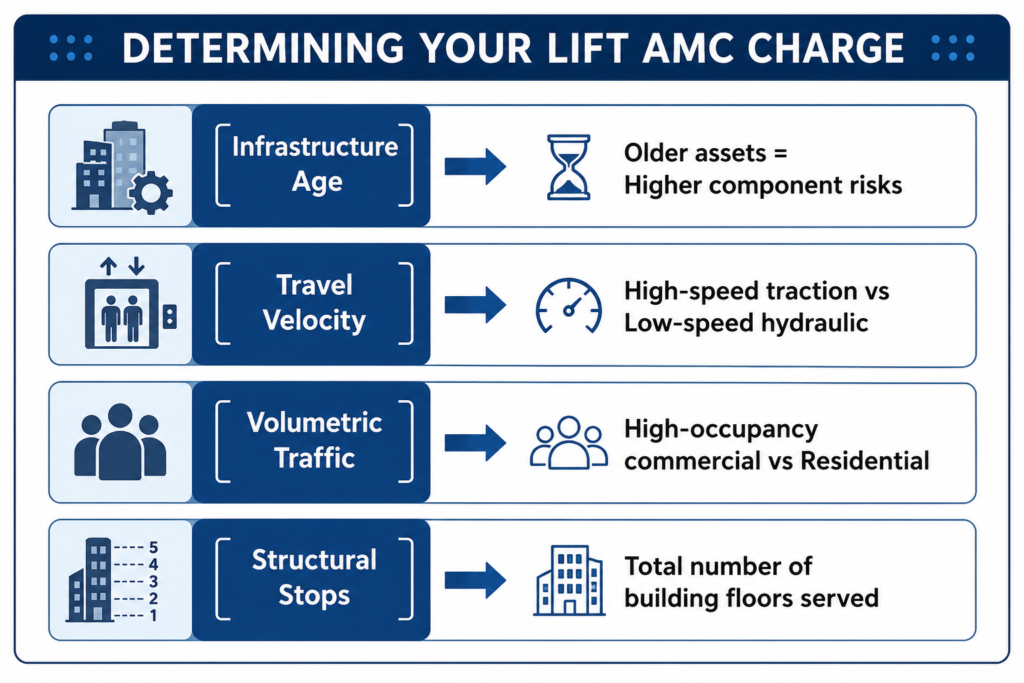
Generally, across the Indian vertical transportation sector, a standard residential elevator service contract can range anywhere from ₹15,000 to ₹60,000+ annually per unit, depending heavily on these operational realities. For example, a basic low-rise hydraulic lift in a private villa requires fewer engineering hours than an advanced, high-speed, Motor-Room-Less (MRL) traction configuration in a commercial high-rise.
By locking in a comprehensive plan, you insulate your community from volatile market spikes in electronic components or sudden emergency service fees. This turns an unpredictable capital risk into a predictable, manageable operating expense.
The Danger of Exclusions: Reading the Fine Print in an Elevator Service Contract
While an all-inclusive contract offers excellent protection, the global elevator industry operates under specific engineering limits. To maintain transparent business relationships, property owners must understand what falls outside a standard elevator service contract. These boundaries are typically defined by external site factors, building infrastructure issues, or intentional damage rather than normal wear and tear:
- Grid Power Irregularities: System failures caused by severe voltage surges, phase imbalances, single-phasing from the municipal grid, or direct lightning strikes.
- Civil Engineering & Environmental Hazards: Structural damage resulting from pit flooding due to poor basement waterproofing, building foundation shifts, or open-shaft water leaks.
- Vandalism and Physical Misuse: Deliberate damage to internal cabin fixtures, cracked mirror finishes, broken operating panels, or structural components warped by overloading the lift beyond its certified weight limits.
- Esthetic Elements: Modernization upgrades, interior cabin redesigns, architectural lighting retrofits, or changing external landing doors for visual style choices rather than functional wear.
Reviewing these standard exclusions highlights the importance of keeping your building’s electrical switchgear rooms properly air-conditioned, maintaining reliable voltage stabilizers, and keeping elevator pits clean and dry.
The Proactive Advantage: Preventing Elevator Breakdown Maintenance
The ultimate goal of executing a comprehensive asset strategy is to drastically reduce instances of emergency lift breakdown maintenance. Waiting for an elevator to fail before calling a technician creates immediate issues for your tenants. It traps residents, disrupts commercial operations, and compromises the building’s emergency evacuation readiness.
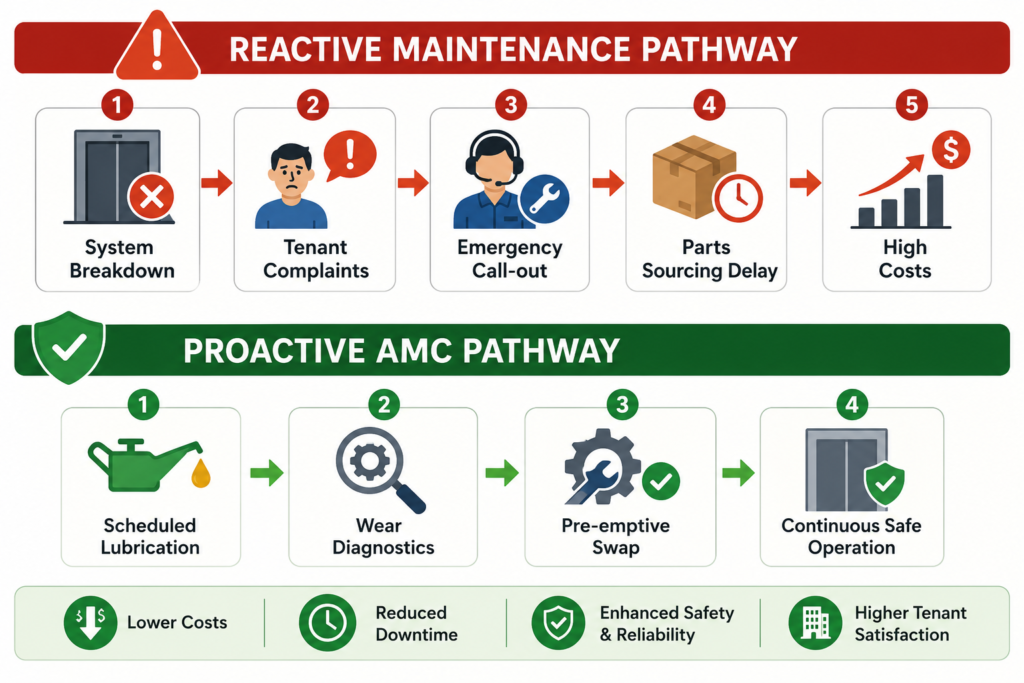
By relying on an elevator service contract centered around preventive engineering, technicians follow a strict, multi-point maintenance checklist during every monthly visit. They check oil levels in hydraulic reservoirs, clean carbon dust from motor brushes, tighten high-vibration terminal connections, and test the responsiveness of the Automatic Rescue Device (ARD).
This proactive care significantly reduces component wear and tear, ensuring that your lift systems run quietly, safely, and efficiently. This extends the working life of your equipment and protects the property values of your real estate investments.
Key Safety Certifications and Regulatory Compliance in India
In India, elevator operations are tightly governed by a strict framework of state legislation, such as the comprehensive Maharashtra Lifts, Escalators and Moving Walks Act, alongside the national safety updates laid out in the National Building Code (NBC). These strict legal guidelines state that regular technical inspections are not optional—they are mandatory requirements for maintaining your building’s valid operating license.
An experienced engineering partner does more than just lubricate moving gears; they actively guide your property through these legal requirements. A comprehensive service contract includes performing regular no-load and full-load safety tests. These tests challenge the car’s safety gear and ensure the mechanical brakes can stop a fully loaded cabin instantly during an overspeed event.
Furthermore, maintaining a meticulous, logbook record of every technical inspection protects building management from legal liabilities if an unexpected accident occurs. For deeper insight into these crucial national building standards and construction safety frameworks, property managers can consult the official Bureau of Indian Standards (BIS) or review the urban safety planning guidelines provided by the Ministry of Housing and Urban Affairs (MoHUA).
Elevate Your Building’s Operational Reliability with Horizon Elevators
Building operations require reliable, stress-free infrastructure management. At Horizon Elevators, we don’t just fix machinery—we deliver long-term peace of mind, improved safety, and continuous vertical performance. As one of Maharashtra’s most trusted elevator engineering institutions, we provide customized Elevator AMC Services that keep your property fully compliant with the latest regulatory standards.
Our service agreements feature an expert team of certified technicians, quick response turnarounds, and 24/7/365 emergency rescue support. Whether you manage a cozy residential community, a sprawling industrial complex, or a high-velocity commercial hub, our comprehensive solutions are carefully designed to eliminate unexpected operational costs and keep your people moving safely.
Don’t wait for a major system breakdown to expose gaps in your property management plan. Protect your residents, secure your equipment investment, and bring predictable budgeting to your building operations today.
Connect with our senior engineering team at Horizon Elevators to schedule a complimentary, professional on-site lift health check and secure a custom Elevator Maintenance Contract tailored precisely to your property’s unique usage patterns.
Frequently Asked Questions (FAQs)
Q1: What is the true lift amc meaning and why does my building need it?
An Elevator Annual Maintenance Contract (AMC) is a formal service agreement between a property owner and a certified elevator engineering specialist. It sets up a proactive schedule of monthly maintenance checkups, component lubrication, safety inspections, and fast emergency response support. It is essential for ensuring continuous passenger safety, maintaining local legal compliance, and avoiding high-cost equipment failures.
Q2: What exact mechanical parts are covered under a comprehensive lift maintenance contract?
A comprehensive plan covers nearly all major functional systems of the elevator. This includes traction motors, drive sheaves, controller circuit boards (PCBs), electromechanical brake assemblies, hoisting ropes, governor systems, door operators, tracks, and landing interlock sensors.
Q3: How is the total lift amc charge calculated for a building?
The overall lift annual maintenance charge is calculated based on specific details of your building’s infrastructure. Key factors include the age of the machinery, the model type (traction, hydraulic, or MRL), the total number of floors served, the travel speed, and the daily passenger traffic patterns.
Q4: Does a standard elevator service contract cover damage from power surges or flooding?
No. Standard engineering contracts exclude issues caused by external factors. This includes severe grid power surges, phase imbalances, building pit flooding due to poor waterproofing, vandalism, or using the lift past its certified weight limits.
Q5: How often should an elevator undergo preventive maintenance inspections?
According to standard industrial practices and Indian regulatory recommendations, elevators in medium-to-high traffic buildings should receive a professional preventive maintenance check at least once every month to ensure optimal safety and performance.