
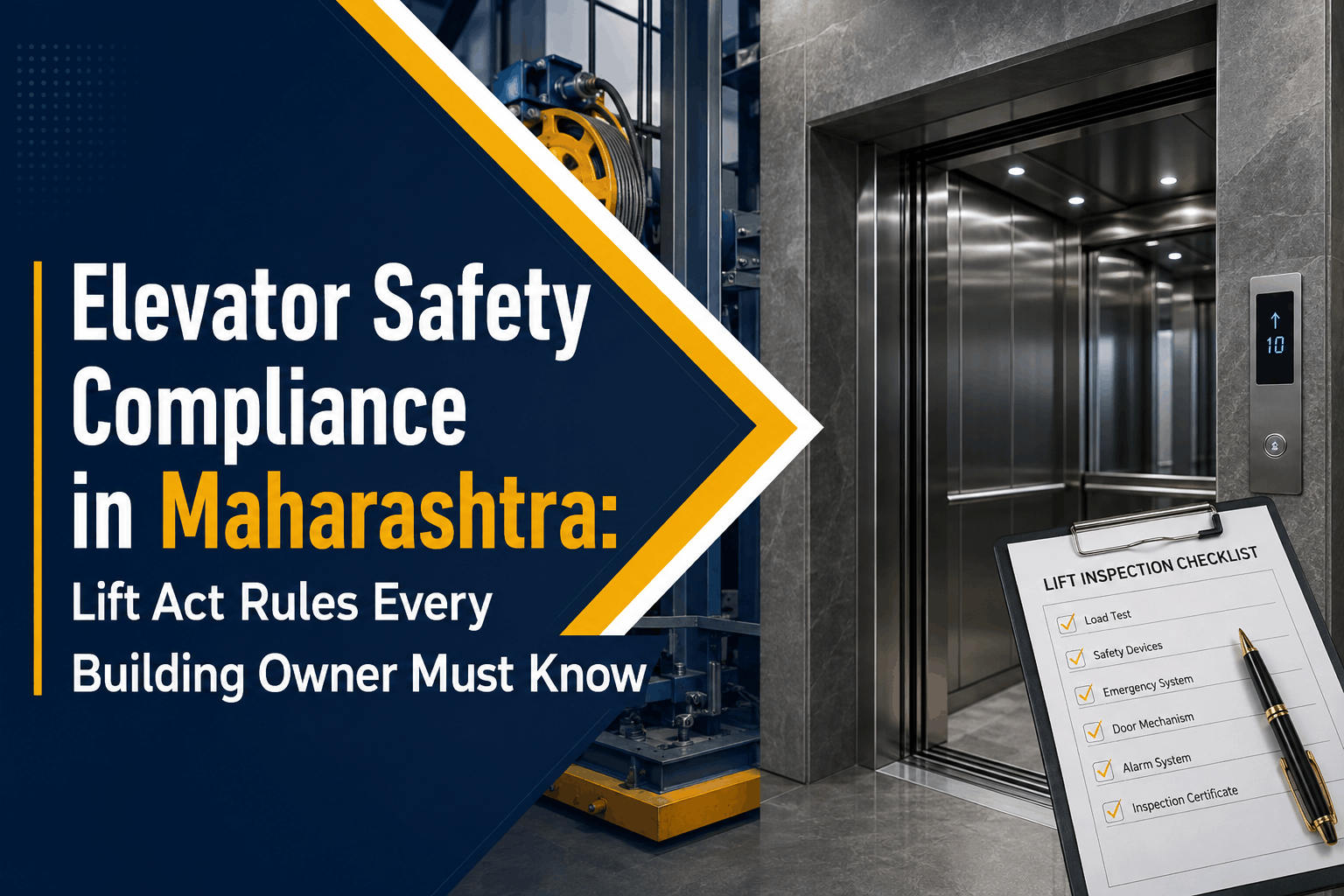
Last Updated on August 27, 2026 by Admin
Navigating vertical transportation management requires navigating strict regulatory frameworks. For building owners, housing society chairpersons, and facility managers across Mumbai, Pune, Nagpur, and Nashik, maintaining lift safety goes far beyond basic mechanical maintenance—it is a mandatory legal obligation. Adhering closely to Maharashtra Lift Act elevator rules ensures smooth vertical travel while shielding property management from severe legal liabilities, steep operational fines, and cataclysmic equipment failures.
Whether managing a residential high-rise housing society or overseeing a sprawling commercial complex, failing to keep up with statutory elevator safety regulations can lead to immediate operational shutdown by state authorities. This comprehensive legal and operational guide covers everything you need to know about statutory provisions under the Maharashtra Lifts, Escalators and Moving Walks Act, technical requirements, licensing procedures, and proactive risk mitigation strategies.
1. Statutory Framework: Understanding the Maharashtra Lifts, Escalators and Moving Walks Act
The foundation of vertical transportation law across the state rests on statutory frameworks designed to preserve public safety in high-density structures. The legislative mandate requires all powered vertical transport systems—from small residential lifts to heavy industrial freight hoists—to be registered, routinely audited, and legally certified before moving a single passenger.
The primary legal milestones for any building owner include:
- 1. Erection Permission: Submit technical layout drawings to the PWD Inspector (Lifts) to verify BIS standards (IS 14665) and structural integrity.
- 2. Post-Installation Testing & Safety Audit: Conduct physical inspection and load testing to validate the Automatic Rescue Device (ARD), fire switches, and interlocks.
- 3. Working License Issuance & Public Display: Obtain the formal state lift operation license, then frame and display it prominently inside the lift car.
- 4. Ongoing Compliance & Operations: Maintain third-party lift insurance coverage, execute monthly servicing through an authorized AMC firm, and file for annual elevator license renewals across Pune, Mumbai, and statewide.
The state enforcing authority strictly mandates that no physical installation work can start without prior permission. Building owners must strictly enforce elevator safety compliance India standards across their properties. The regulatory body oversees:
- Erection Authorization: Formal permission required prior to starting structural, mechanical, or electrical work on a lift shaft.
- Operational Licensing: Final clearance enabling legal operation after passing comprehensive load and safety mechanism tests.
- Periodic State Audits: Scheduled mandatory reviews by designated government inspectors to confirm ongoing mechanical integrity.
2. Core Operational Duties under Maharashtra Lift Act Elevator Rules
Legal accountability under the state lift act rests squarely on the shoulders of the property owner, society management board, or designated facility manager. Under Maharashtra Lift Act elevator rules, ignoring operational guidelines or delaying maintenance logs constitutes a direct statutory violation.
Key statutory obligations for property managers include:
- Obtaining the Initial License: Operating an unlicensed elevator is a criminal defense violation. Owners must secure a valid operating license from the Chief Electrical Inspectorate before making the lift available to residents or workers.
- Display of Legal Notices: The issued license, passenger weight/person capacity limits, and emergency contact procedures must be permanently framed and clearly visible inside every lift cabin.
- Mandatory Incident Reporting: If a mechanical failure, sudden free-fall arrest, cable snap, or physical injury occurs, the owner must notify the state inspectorate within 24 hours and halt operation until a complete technical assessment takes place.
- Maintaining On-Site Logbooks: Facilities must maintain comprehensive maintenance physical logs on-site, recording all monthly preventative maintenance services, component replacements, and technical adjustments made by service engineers.
3. Mandatory Inspections: Roles of the PWD Lift Inspector Pune and State Authorities
Securing and retaining a valid lift inspection certificate Maharashtra involves rigorous technical inspections overseen by state-appointed electrical inspectors. For properties operating within urban hubs like Pune, Pimpri-Chinchwad, and the broader Mumbai Metropolitan Region, coordination with a certified PWD lift inspector Pune or regional state officer is essential for ongoing legal authorization.
| Compliance Focus Area | Minimum Testing Frequency | Regulatory Enforcing Agency |
| Physical Inspection Audit | Annual / Periodic | PWD State Lift Inspectorate |
| Preventative Service AMC | Monthly | Certified Elevator OEM/Firm |
| License Renewal Filing | Annual (State Mandate) | Chief Electrical Inspector |
The inspector evaluates critical mechanical, structural, and electrical safety systems. Every compliance inspection rigorously tests:
- Braking Systems & Overspeed Governors: Verifying that mechanical safety brakes engage instantly if the cabin exceeds safe rated speeds.
- Door Locks & Mechanical Interlocks: Ensuring elevator landing doors cannot open unless the car is safely leveled at the landing zone.
- Emergency Lighting and Alarm Systems: Testing battery-backed cabin alarms, intercom units, and ventilation fans during total power outages.
- Automatic Rescue Devices (ARD): Confirming that power-failure rescue systems automatically bring the cabin to the nearest floor level and open the doors during grid interruptions.
To verify national safety standards governing installation parameters, refer to the technical specifications outlined by the official Bureau of Indian Standards (BIS).
4. Periodic Audits and Renewals: Lift License Renewal Pune Procedures
A common operational error made by housing societies is assuming an initial elevator license remains valid indefinitely. Under state guidelines, lift safety regulations for building owners require periodic license validation and strict adherence to elevator periodic inspection rules.
When completing an elevator license renewal Pune or elsewhere in Maharashtra, facility managers must follow a clear administrative process:
- Step 1: Maintain AMC Documentation: Secure an active maintenance contract with a licensed elevator service enterprise. Uncertified third-party technicians cannot legally issue compliance documentation.
- Step 2: Complete Pre-Inspection Technical Audit: Run a comprehensive elevator safety audit checklist to identify cable wear, electrical ground issues, or leveling inaccuracies before the state officer visits.
- Step 3: Submit Renewal Application: Submit the official renewal forms, annual state inspection fees, active AMC contract copies, and current third-party insurance policies to the PWD Electrical Inspectorate.
- Step 4: Receive Statutory Inspection Certificate: Upon successful physical inspection, the state issues an updated government elevator license certificate, which must be displayed in your facility’s records and inside the lift car.
To maintain long-term reliability and secure rapid compliance clearance during PWD inspections, explore full-scope preventative maintenance programs via Horizon Elevators AMC Services.
5. Risk Management: Elevator Accident Liability and Insurance Obligations
Mechanical failures and safety oversights carry heavy operational, financial, and civil consequences. Establishing robust building safety compliance for lifts requires implementing effective structural risk-mitigation strategies alongside mechanical upkeep.
Understanding Legal Liability
If an elevator accident occurs due to ignored maintenance, bypassed safety interlocks, or an expired operating license, legal liability falls directly on the building owner or managing committee members. Under statutory negligence provisions, committee leaders can face personal civil lawsuits, heavy administrative fines, or criminal proceedings.
Statutory Third-Party Insurance Requirements
To protect building management and passengers, maintaining a comprehensive lift insurance requirement policy is mandatory across commercial and residential structures. Insurance coverage must include:
- Third-Party Public Liability Insurance: Provides financial coverage for passenger injuries or accidental loss of life within the elevator cabin or shaft premises.
- Property Damage Protection: Covers structural damage caused by unexpected mechanical or electrical system breakdowns.
Insurance claims may be rendered completely void if state authorities discover the elevator was operating with an expired inspection license or an uncertified maintenance provider during the incident.
Learn more about managing infrastructure risks and ensuring legal compliance across real estate developments by reviewing statutory frameworks on the Government of Maharashtra Official Portal.
6. Comprehensive Inspection Checklist for Facility Managers
Using a systematic elevator safety audit checklist allows building staff to spot mechanical warnings early and avoid costly compliance failures. Conduct routine reviews across these primary operational zones:
A. Operational Audit Checklist Items
- Displayed License: Confirm the valid operating license is framed and visible inside the car.
- ARD Functionality: Ensure the automatic rescue system operates correctly under simulated power loss.
- Emergency Lighting & Alarm: Verify that the 30-minute battery backup power functions fully.
- Door Interlocks: Check that doors halt when obstructed and remain locked while traveling between floors.
- Leveling Accuracy: Confirm the cabin aligns flush within ±5mm of each floor landing.
- Cable Integrity: Inspect hoist ropes for signs of fraying, tension imbalance, or surface rust.
- Overspeed Governor: Verify that the mechanical trip assembly is calibrated and tested.
- Pit Cleanliness: Ensure the elevator pit is completely free of water, rubbish, and oil accumulation.
- AMC Logs: Confirm monthly servicing records are signed off on-site by an authorized technician.
B. Cabin Interior and Landing Zones
- Confirm smooth floor-leveling accuracy to prevent tripping risks.
- Test cabin call buttons, emergency stop switches, and door re-open sensors.
- Check that cabin lighting, ventilation fans, and two-way intercom systems operate on backup power.
C. Machine Room and Electrical Shaft Drive
- Verify machine room ambient temperature and ensure control panels remain completely dust-free.
- Inspect main traction sheaves, brake pads, and motor gearboxes for unusual oil leaks or excessive vibration.
- Test overspeed governor assemblies and main electrical breaker isolation switches.
For upgraded residential elevator solutions engineered to meet all current state safety standards, view modern installations at Horizon Elevators Residential Lifts.
7. Operational Upgrades: Modernization vs. Full Replacement
As elevators age, maintaining full compliance under evolving Maharashtra Lift Act elevator rules becomes harder and more expensive. Components wear out, spare parts become obsolete, and older control systems struggle to meet modern energy and safety requirements.
| Operational Requirement | Minor Repair / Servicing | Full Lift Modernization |
| Average Equipment Age | 0 – 8 Years | 12+ Years |
| Breakdowns & Down-Time | Rare, isolated faults | Frequent component failures |
| Regulatory Compliance | Meets original standards | Needs updated ARD/BIS rules |
| Operational Efficiency | High performance | High energy consumption |
Modernization replaces outdated control panels, geared traction machines, door drives, and safety gear with state-of-the-art microprocessors and variable-frequency drives (VFDs). Modernizing your lift system delivers significant operational advantages:
- Improved Energy Efficiency: Modern gearless traction machines cut electricity consumption by up to 40% compared to legacy systems.
- Smoother Ride & Precise Leveling: VFD drives eliminate sudden stops and jerky starts, guaranteeing accurate floor leveling.
- Faster Inspection Clearances: Upgrading safety systems ensures swift approvals during periodic state audits.
To explore cost-effective modernization strategies designed to keep aging equipment fully compliant, consult the specialized solutions available at Horizon Elevators Commercial Systems.
Partner with Horizon Elevators for Complete Safety and Compliance
Maintaining elevator safety requires more than checking off legal requirements—it ensures the long-term safety, convenience, and value of your property. Partnering with an experienced, state-licensed elevator engineering company helps you simplify regulatory compliance and avoid costly administrative delays.
At Horizon Elevators, we provide end-to-end vertical transportation engineering services across Maharashtra. Our team manages every phase of the lift lifecycle, including:
- Turnkey installation compliant with BIS and Maharashtra Lift Act standards.
- Full support for PWD inspections, documentation, and lift license renewal Pune procedures.
- Customized Annual Maintenance Contracts (AMC) with 24/7 emergency rescue support.
- Advanced modernization packages tailored for residential high-rises, commercial hubs, and industrial facilities.
Protect your occupants and keep your property fully compliant. Contact Horizon Elevators today to schedule an expert technical audit or request a personalized maintenance consultation.
Frequently Asked Questions (Q&A)
Q1: Is an Automatic Rescue Device (ARD) mandatory for all lifts in Maharashtra?
Yes. Under state safety regulations, all passenger elevators installed in residential and commercial buildings must feature a functional Automatic Rescue Device (ARD). The system automatically brings the car to the nearest floor and opens the doors during power outages.
Q2: What happens if a building operates an elevator with an expired license?
Operating an elevator with an expired license violates the Maharashtra Lift Act. Authorities can issue immediate shutdown orders, impose daily administrative fines, and hold property owners legally liable for any accidents during the period of non-compliance.
Q3: How frequently must elevators undergo official PWD inspections?
State inspectors conduct periodic physical safety audits. Building owners must maintain active maintenance contracts, keep detailed monthly service logs, and renew operational licenses annually.
Q4: Who is held legally responsible if an elevator accident occurs?
Primary legal responsibility rests with the property owner, society managing committee, or facility management authority. If an accident results from neglected maintenance or operating without a valid license, responsible parties face civil claims and statutory penalties.
Q5: Can any local technician perform mandatory monthly elevator servicing?
No. Servicing and repairs must be conducted by authorized technicians working for certified elevator maintenance firms. Unlicensed maintenance invalidates inspection filings and insurance claims.