
Last Updated on September 24, 2026 by Admin
Selecting vertical transportation equipment for a manufacturing plant, logistics hub, or multi-story warehouse is one of the most critical operational decisions an industrial facility manager will ever make. Modern supply chains demand speed, precision, and zero downtime. However, internal logistics often grind to a agonizing halt because of a single bottleneck: an improperly specified lift system.
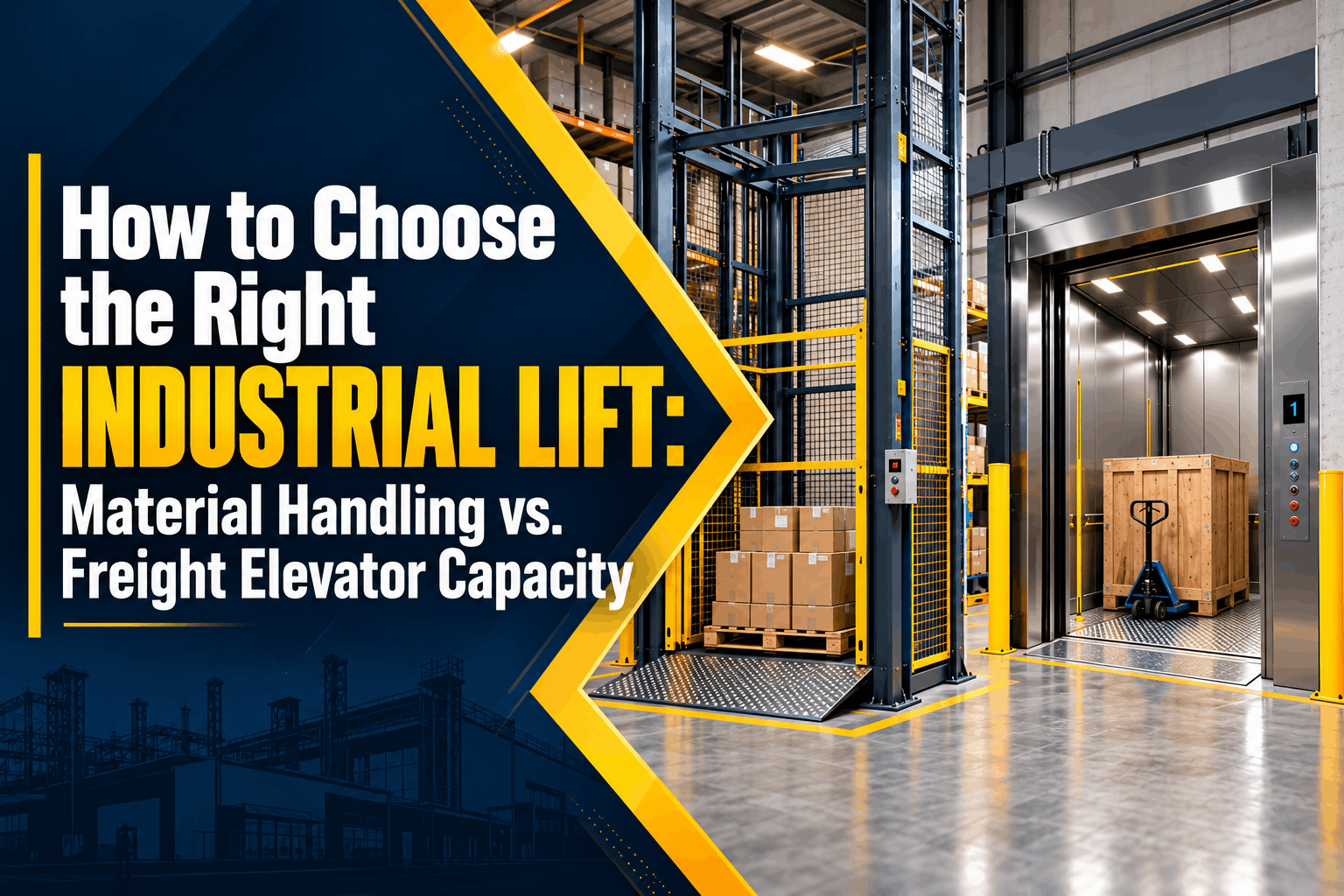
When facility owners plan their material movement layout, they frequently struggle with a core question: How to Choose the Right Industrial Lift: Material Handling vs. Freight Elevator Capacity?
Choosing between a vertical material handling lift (such as a goods lift or scissor platform) and a heavy-duty freight elevator involves far more than simply picking a size from a catalog. It requires a detailed evaluation of payload requirements, structural engineering, drive systems, loading methods, regulatory compliance, and long-term operating costs.
In this comprehensive guide, we will break down the essential technical and operational factors required to make the right choice. By evaluating the structural and mechanical differences between material handling equipment and high-capacity freight elevators, you can safeguard your workers, streamline workflow, and maximize profitability.
Understanding Vertical Transportation in Modern Facilities
Industrial environments rely heavily on vertical mobility to keep raw materials moving into production lines and finished products flowing out to distribution bays. A failure in vertical transport disrupts the entire supply chain.
When analyzing how to choose the right industrial lift: material handling vs. freight elevator capacity, you must first categorize what you are transporting and who is accompanying it.
What is an Industrial Material Handling Lift?
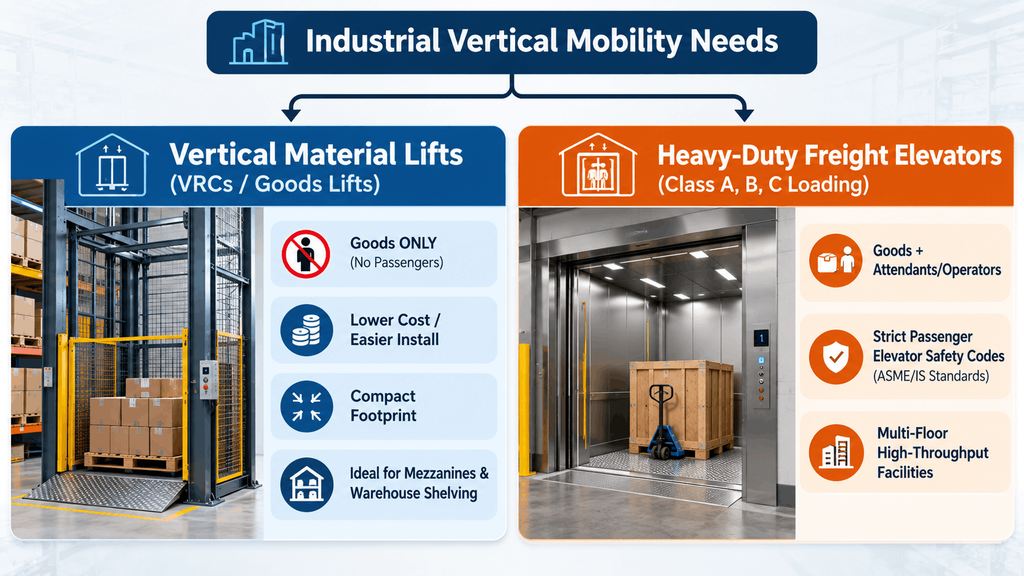
A vertical material handling lift—often referred to as a Vertical Reciprocating Conveyor (VRC) or a specialized goods lift—is custom-engineered to transport cargo, pallets, inventory trays, and equipment between building levels.
- Primary Purpose: Pure cargo movement.
- Passenger Rule: Strictly prohibited. No personnel are allowed to ride inside or on the platform.
- Regulatory Standard: Governed primarily by material handling conveyor safety standards rather than traditional passenger elevator codes.
- Best Uses: Mezzanine storage access, automated inventory management, parts transfers, and connecting shop floor levels.
What is an Industrial Freight Elevator?
An industrial freight elevator is a robust, heavy-duty elevator designed explicitly to carry heavy freight alongside authorized operators, forklift drivers, or material handling staff.
- Primary Purpose: Integrated transport of heavy cargo AND personnel.
- Passenger Rule: Permitted for trained operators, attendants, and ride-along material handlers.
- Regulatory Standard: Built to strict national and international elevator codes (such as IS 14665 in India or ASME A17.1 internationally), featuring comprehensive hoistway protection, interlocking doors, and fail-safe braking mechanisms.
- Best Uses: Multi-story manufacturing facilities, heavy machinery plants, high-rise warehouses, and medical or commercial centers requiring massive bulk transport.
Material Handling Lifts vs. Freight Elevator Capacity: Key Technical Differences
Understanding how these systems differ mechanically and structurally helps avoid purchasing an over-engineered system that drains your budget or an under-engineered system that violates safety laws.
| Feature / Metric | Material Handling Lift (Goods Lift / VRC) | Heavy-Duty Freight Elevator |
| Rider Allowance | Material/Cargo ONLY | Cargo + Operating Personnel |
| Typical Load Capacity | 500 kg to 3,000 kg | 1,000 kg to 10,000+ kg (5+ Tons) |
| Drive Systems | Hydraulic Powerpack or Chain/Rope Drive | Hydraulic Traction or Geared/Gearless Traction |
| Operating Speed | 0.15 m/sec to 0.3 m/sec | 0.3 m/sec to 1.5+ m/sec |
| Pit & Overhead Depth | Minimal pit required (or surface ramp) | Standard deep pit and overhead clearances |
| Regulatory Standards | Conveyor / Material Handling Safety Rules | Full Elevator Safety Codes (IS / ASME Standards) |
| Initial Capital Investment | Cost-effective; moderate installation | Higher capital cost; specialized construction |
Critical Factors for Calculating Industrial Lift Capacity
Calculating the required payload rating is the foundation of how to choose the right industrial lift: material handling vs. freight elevator capacity. Underestimating your weight requirements leads to premature mechanical wear, drive failure, and severe safety hazards. Overestimating can unnecessarily inflate civil construction and equipment costs.
To establish the exact load dynamic for your enterprise, evaluate these key parameters:
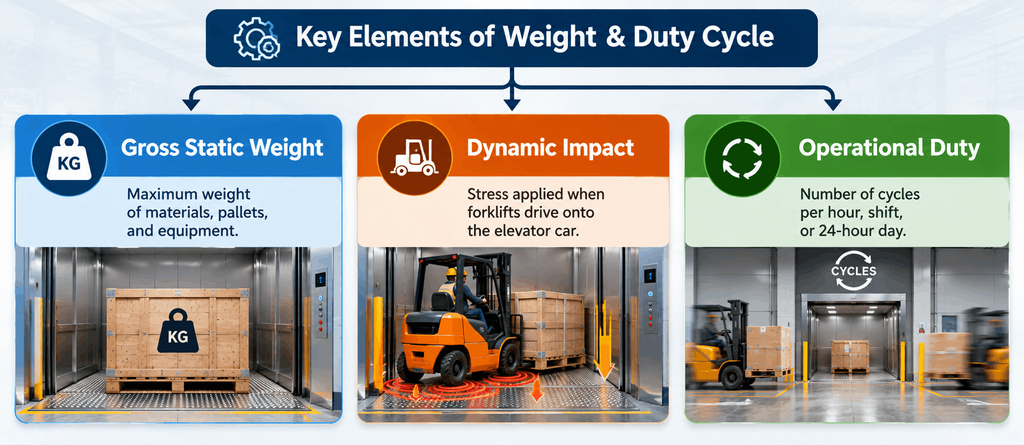
Total Weight Calculation = Material Payload + Transport Equipment (Forklift/Pallet Jack) + Rider Weight (if Freight Elevator)
1. Static vs. Dynamic Loading (The Forklift Impact Factor)
A common mistake in warehouse design is sizing an elevator based solely on the weight of the static pallet.
When a 2,500 kg ride-on forklift drives into an elevator car carrying a 1,500 kg pallet, the total static load is 4,000 kg. However, as the forklift brakes on the elevator platform, it exerts dynamic kinetic forces that temporarily exceed 5,000 kg.
For this reason, industrial elevator classifications account for method of loading:
- Class A (General Freight Loading): Distributed loads loaded manually or via hand trucks where no single piece exceeds 25% of the rated capacity.
- Class B (Motor Vehicle Loading): Designed exclusively to transport automobiles or trucks.
- Class C1 (Industrial Truck Loading): Accommodates a power industrial truck (like a forklift) riding inside the elevator alongside the load.
- Class C2 (Industrial Truck Loading): Allows a forklift to drive onto the platform to load cargo, but the truck does not ride with the elevator during travel.
- Class C3 (Heavy Concentrated Loading): For massive single-piece items where the truck load matches the total platform capacity.
If your facility relies on motorized forklifts, choosing a high-capacity freight elevator built for Class C1 or C2 industrial truck loading is essential to prevent floor deformation and car frame alignment failure.
2. Physical Dimensions and Door Clearances
Capacity is not just about weight; it is also about volume and clearance. You must measure:
- Usable Floor Area: Length $\times$ Width of the lift car floor.
- Vertical Clearance: Clear cabin height and door frame clearance for tall pallet stacks.
- Door Opening Type: Center-opening, vertical bi-parting, or side-sliding doors. Vertical bi-parting doors maximize usable entrance width for wide cargo.
3. Operational Duty Cycle
How many trips will the lift make per hour?
- Low-to-Medium Duty: Intermittent transfers (5–10 trips/hour) between shop floor and mezzanine are ideal for hydraulic material handling lifts.
- High-Throughput Continuous Duty: Multi-shift production lines requiring 30–60 trips/hour across multiple floors demand a high-speed traction freight elevator with durable guide rails and heavy-duty brake systems.
Drive Technologies: Hydraulic Lifts vs. Traction Elevators
Selecting the correct drive engine dictates running costs, lifting smoothness, and maintenance requirements.
Hydraulic Industrial Lifts
Hydraulic drive systems use a motor-driven fluid pump to extend a piston, lifting the elevator car. Modern systems utilize advanced powerpacks (such as GMV Italy hydraulic powerpacks) to provide ultra-smooth movement.
- Advantages: Exceptionally strong lifting power for extreme loads; low overhead clearance needs; simple structural support requirements (weight rests on the pit floor, not the building ceiling).
- Limitations: Limited travel heights (typically under 18–20 meters) and lower speed (0.15–0.5 m/s).
- Best Suited For: Warehouses, factory shop floors, 2 to 4-story mezzanines, and scissor platform lifts.
Traction Industrial Elevators
Traction systems use steel wire ropes or flat belts passing over a driven sheave with counterweights. They can be Geared, Gearless, or Machine Room-Less (MRL).
- Advantages: High travel speeds; unlimited vertical height capability; excellent energy efficiency during continuous operations.
- Limitations: Requires higher overhead clearance, a deep pit, and stronger hoistway wall support.
- Best Suited For: Multi-level commercial structures, tall manufacturing plants, and high-volume multi-floor logistics hubs.
To review international standard guidelines on vertical transport equipment engineering and safety compliance, consult the American Society of Mechanical Engineers (ASME A17.1 Standards) or explore technical industrial engineering frameworks on IEEE Xplore.
Key Safety Protocols and Structural Compliance
Safety is non-negotiable in material movement. Industrial accidents involving lifts lead to costly structural damage, lost production, and severe legal liability.
When evaluating a manufacturer, verify that the industrial lift features these critical safety mechanisms:
- Mechanical & Electrical Door Interlocks: Ensures hoistway doors cannot open unless the elevator car is parked safely at that specific landing floor.
- Overload Protection Devices: Load cells embedded in the car frame sound an audible alarm and lock the control panel if payload capacity is exceeded.
- Emergency Braking & Progressive Safety Gears: Mechanical safety clamps instantly grip the guide rails if the lift exceeds safe travel speed or experiences cable slack.
- Automatic Rescue Device (ARD): Battery-operated emergency rescue systems automatically navigate the lift car to the nearest landing floor during a power outage, opening the doors to protect operators or perishable goods.
- AGV / AMR Integration Compatibility: Modern smart factories require industrial lifts that integrate with Automated Guided Vehicles (AGVs) through wireless PLC interlocks, allowing autonomous robots to enter, select floors, and exit without human intervention.
Step-by-Step Decision Guide: Which Lift Does Your Site Need?
Use this decision matrix to determine whether a material handling lift or a full freight elevator best fits your operational workflow:
Scenario A: Warehouse Mezzanine Storage
- Need: Moving box crates, palletized goods, and inventory trays between ground level and a mezzanine shelf. Personnel use nearby stairs.
- Optimal Solution: A compact Hydraulic Goods Lift or Platform Lift. It offers minimal installation footprint, requires no deep pit, and optimizes capital investment.
Scenario B: Multi-Story Heavy Manufacturing Plant
- Need: Moving 4-ton raw material dies, moulds, and heavy equipment across 5 floors. Operators ride alongside the machinery on forklift trucks.
- Optimal Solution: A heavy-duty Class C1 Traction Freight Elevator featuring a 5,000 kg capacity, vertical bi-parting doors, and reinforced cabin floor plates.
Scenario C: High-Volume Distribution Hub with Automated Robots
- Need: Continuous automated movement of goods via Automated Guided Vehicles (AGVs).
- Optimal Solution: An AGV-Integrated Industrial Goods Elevator featuring PLC signal sync, precision floor leveling, and laser safety curtains.
Elevate Your Industrial Material Handling with Horizon Elevators
Selecting the correct industrial lift requires deep technical expertise, robust engineering, and an unyielding commitment to safety. At Horizon Elevators, we specialize in designing, manufacturing, and installing high-performance vertical mobility systems tailored to your exact facility layout.
As an ISO 9001:2015 certified manufacturer, Horizon Elevators engineers industrial lifting solutions engineered to handle demanding operational environments across India.
Why Leading Industries Choose Horizon Elevators:
- Custom Load Capacities: Precision-engineered goods lifts and freight elevators handling payloads from 500 kg up to 5,000 kg (5 Tons).
- Advanced Hydraulics & Traction: Powered by premium drive components—including GMV Italy hydraulic powerpacks—for smooth performance, minimum noise, and maximum energy efficiency.
- Uncompromising Safety Systems: Equipped with mechanical and electrical door interlocks, progressive safety gear, overload indicators, and emergency brake protection.
- Smart Factory Ready: Seamless integration with AGV/AMR autonomous systems, inventory trays, and smart warehouse networks.
- End-to-End Execution: From initial site assessment and custom engineering to complete installation, testing, and 24/7 Annual Maintenance Contracts (AMC).
Discover our complete range of specialized industrial solutions by exploring our Industrial Lifts Services, learn more about our quality commitment on our About Horizon Elevators Page, or explore custom engineering models on the Horizon Elevators Official Portal.
Ready to eliminate facility bottlenecks and upgrade your material handling efficiency?
Contact our engineering experts today for a comprehensive site assessment and custom industrial lift quotation!
Frequently Asked Questions (Q&A)
Q1: What is the primary difference between a material handling lift and a freight elevator?
The primary difference lies in rider permission and regulatory compliance. A material handling lift (or goods lift/VRC) is strictly designed to transport cargo and materials only—no passengers or operators are permitted to ride inside. A freight elevator is built to full elevator safety codes, allowing authorized personnel and equipment operators to ride along with the heavy cargo.
Q2: How do I calculate the freight elevator capacity my factory needs?
To calculate required freight elevator capacity, sum the maximum combined weight of your material payload, the pallets/containers, the transport vehicle (such as a forklift or electric pallet jack), and the operator. Additionally, account for dynamic loading forces if forklifts will drive directly into the elevator car, selecting an appropriate Class C loading rating.
Q3: Do goods lifts require a deep pit and machine room?
Not always. Many modern hydraulic goods lifts and Machine Room-Less (MRL) vertical material lifts require minimal pit depths (sometimes as little as 100 mm to 300 mm, or a shallow surface ramp) and no dedicated machine room overhead. This makes them ideal for retrofit installations on existing facility shop floors.
Q4: Can a material handling lift be integrated with Automated Guided Vehicles (AGVs)?
Yes. Modern industrial material handling lifts engineered by Horizon Elevators can be fitted with advanced PLC interface controls, automated landing doors, and laser positioning sensors that communicate wirelessly with AGVs and AMRs for completely automated material transfers.
Q5: How often should an industrial freight elevator undergo AMC maintenance?
Because industrial lifts operate under heavy loads and harsh environments, routine preventive maintenance should be conducted monthly under a comprehensive Annual Maintenance Contract (AMC). Regular inspections ensure door interlocks, braking systems, hydraulic oil levels, and drive cables operate at peak safety standards.