
Last Updated on August 7, 2026 by Admin
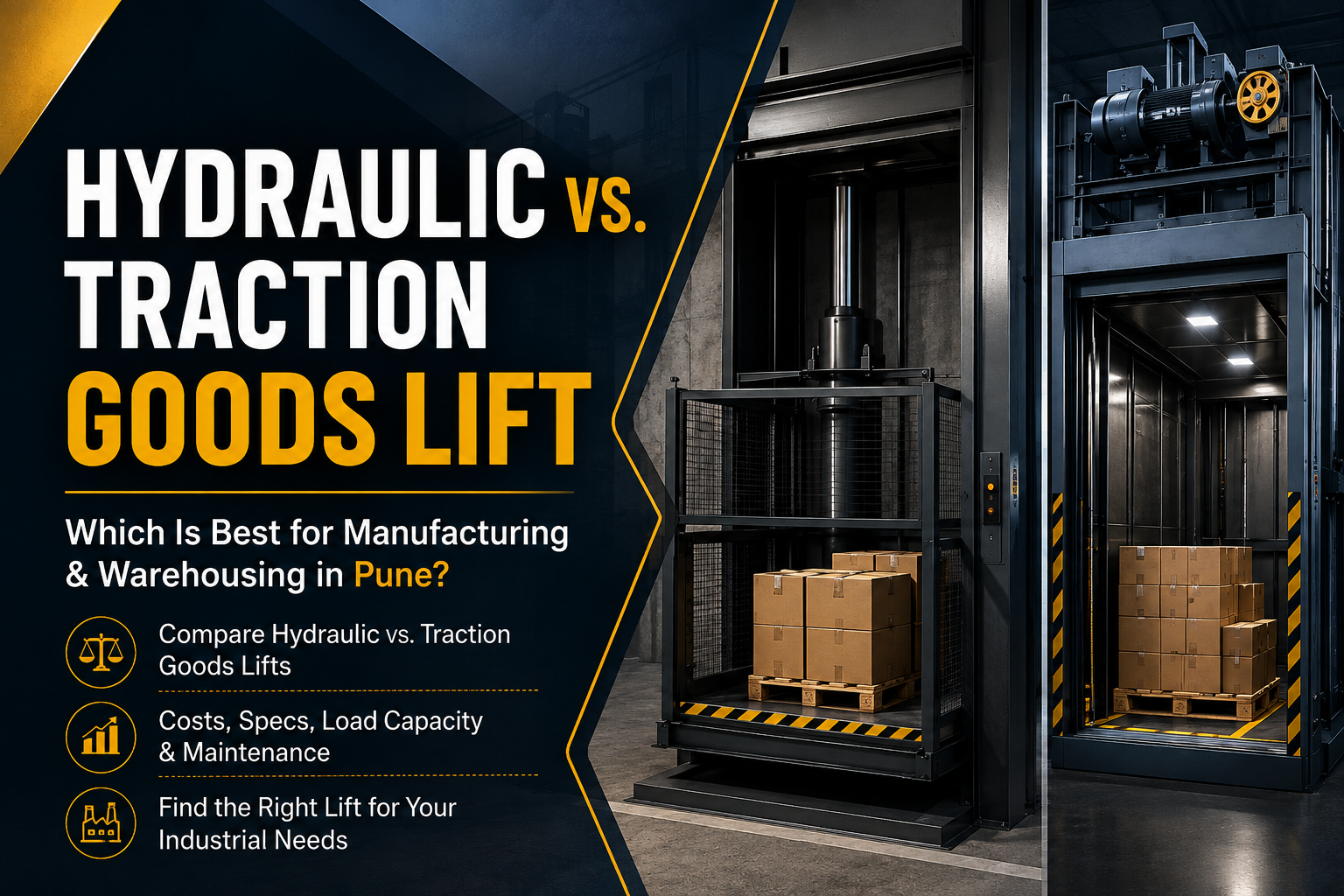
Selecting the right industrial vertical transport system is one of the most critical decisions a factory or facility manager will make. In Pune’s rapidly expanding industrial belts—such as Chakan, Bhosari, Talegaon, Hadapsar, and Ranjangaon—smooth material movement directly influences overall operational throughput. When investing in an industrial vertical transport solution, logistics leads and operations supervisors inevitably face a key technical dilemma: Hydraulic Goods Lift vs. Traction Goods Lift: Which Is Best for Manufacturing & Warehousing in Pune? Choosing the correct hydraulic goods lift in pune requires a careful evaluation of structural requirements, operational speed, long-term energy consumption, and load handling requirements.
Selecting an mismatched elevator system can lead to severe bottlenecks, frequent downtime, excessive power expenses, and expensive structural alterations. Whether you operate a high-turnover automotive assembly plant in Chakan, an electronics assembly hub in Hinjewadi, or a multi-tier distribution center near the Mumbai-Pune Expressway, understanding the core mechanical differences between hydraulic cylinder mechanisms and electric traction drive systems is essential for maximizing ROI.
This detailed engineering and financial comparison breaks down mechanics, installation prerequisites, load capabilities, maintenance profiles, and real-world costs to help you select the ideal vertical transport system for your Pune manufacturing or logistics facility.
Understanding the Mechanics: Hydraulic vs. Traction Systems
Before evaluating costs and operational parameters, it is helpful to examine how these two distinct engineering systems generate vertical lift movement.
How a Hydraulic Goods Lift Works
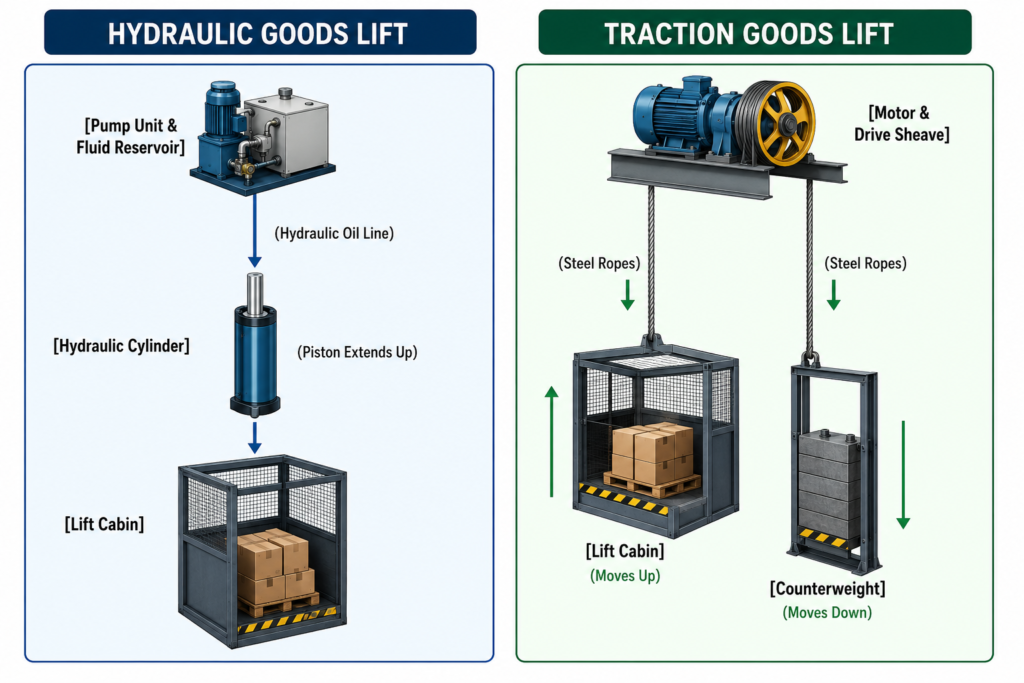
A hydraulic goods lift utilizes a high-pressure hydraulic cylinder lifting mechanism connected to an electrically driven pump unit. To elevate the platform or cabin, an electric motor pumps specialized hydraulic oil from a fluid reservoir into the cylinder. This pressure extends a steel piston, pushing the elevator car upward along guide rails.
To lower the car, the system opens an electronically controlled control valve, allowing gravity to gently push the oil back into the reservoir without requiring active motor power. This mechanical layout makes hydraulic systems exceptionally sturdy, physically robust, and capable of handling intense direct impact loads during forklift loading operations.
How a Traction Goods Lift Works
A traction goods lift relies on electric traction drives. Heavy-duty steel wire ropes or flat polyurethane belts pass over a groove-cut drive sheave connected to an electric motor (geared or gearless permanent magnet synchronous motor). The cabin is suspended on one end of the ropes, while a calculated counterweight balances the load on the opposite side.
As the electric motor turns the sheave, friction between the steel cables and the drive sheave pulls the car upward or downward. Because the counterweight offsets approximately 40% to 50% of the maximum cabin weight, traction elevators require less electrical power to move heavy loads continuously over multiple floors.
Key Comparison Parameters for Pune Manufacturers and Warehouses
To determine whether a hydraulic goods lift or a traction goods lift aligns with your facility, evaluate these critical operational attributes:
1. Travel Height and Floor Level Capabilities
If your manufacturing facility or warehouse operates across 2 to 4 levels (Ground + 1 to Ground + 3 floors), a hydraulic system excels. Hydraulic cylinders have practical stroke-length constraints; elevating a car beyond 15 to 18 meters requires multi-stage telescopic rams or indirect chain-guided systems.
Conversely, if your logistics hub or high-density storage building spans 5 or more levels (up to G+10), a traction goods lift is the standard choice. Traction systems utilize suspension cables rather than rigid pistons, meaning vertical travel height is limited only by building architecture and steel rope lengths.
2. Lifting Speed and Duty Cycle Demands
Speed directly dictates material throughput in high-velocity logistics centers:
- Hydraulic Lifts: Travel at deliberate, highly controlled speeds, usually ranging from 0.15 m/s to 0.5 m/s. This controlled pace provides exceptional stability when moving delicate components, heavy fluid vats, or unstacked pallets.
- Traction Lifts: Deliver high travel speeds, ranging from 0.5 m/s to over 2.0 m/s. For multi-story commercial distribution centers handling high-frequency goods movement, traction systems move items between floors significantly faster.
3. Load Capacity and Structural Floor Rigidity
When transferring heavy pallets using electric stackers, hand pallet trucks, or heavy-duty forklifts, the elevator car experiences sudden, severe point-impact stresses during loading:
- Hydraulic Systems: Direct mechanical support from a solid oil column beneath or beside the car prevents cabin dipping or bouncing when heavy machinery rolls onto the floor. This structural stability makes hydraulic units ideal as a factory material transport lift.
- Traction Systems: Because traction cars hang suspended from overhead ropes, loading heavy industrial machinery can cause minor spring action or rope elongation. Specialized floor-locking devices are required on traction units handling heavy point-loads to prevent alignment gaps at floor thresholds.
Technical Specifications Comparison
When drafting engineering proposals or reviewing warehouse goods elevator specifications, consult this detailed technical baseline:
| Specification Attribute | Hydraulic Goods Lift Standard | Traction Goods Lift Standard |
| Goods Elevator Load Capacity | 500 kg up to 10,000 kg (10 Tons) | 500 kg up to 5,000 kg (5 Tons) |
| Motor Drive Type | Submerged Hydraulic Pump / Power Pack | Geared Traction / Gearless MRL Drive |
| Pit Depth Requirement | Shallow Pit (300 mm to 600 mm) | Deep Pit (1200 mm to 1800 mm) |
| Overhead Headroom Clear | Low Clearance (3200 mm to 3600 mm) | Standard Clear (4200 mm to 4800 mm) |
| Machine Room Requirement | Optional / Side Machine Unit | Top Machine Room or MRL Shaft Side |
| Power Consumption Profile | Power used ONLY during ascent | Power used during ascent & descent |
| Safety System Features | Rupture Valve, Manual Drop Valve | Speed Governor, Safety Clamps |
Civil Works, Spatial Efficiency, and Installation Logistics
For industrial companies in Pune looking to retrofit an elevator into an existing structure, civil alteration costs can rival the purchase price of the lift itself.
Pit Depth and Overhead Space Constraints
- Hydraulic Lifts: Require minimal pit depths—often as shallow as 300 mm to 500 mm. In many instances, if digging into the facility floor is impossible due to underground utilities or bedrock, a small ramp can be installed at floor level. Overhead headroom requirements are similarly minimal.
- Traction Lifts: Require a concrete pit at least 1,200 mm to 1,800 mm deep to house buffer springs, safety frames, and counterweight runby clearances. Overhead clearance must also be substantial (often exceeding 4,200 mm) to accommodate top safety frames and speed governor mechanisms.
Machine Room Flexibility
Hydraulic systems offer significant installation flexibility. The hydraulic power pack and control panel do not need to be situated directly above or adjacent to the shaft. They can be placed in a compact enclosure up to 10–15 meters away from the lift shaft.
Traction systems traditionally require a dedicated structural machine room directly above the hoistway. Modern machine room-less goods lift (MRL) traction designs eliminate this top room by mounting a compact gearless motor inside the shaft headroom, though this setup still demands higher vertical clearance than a standard hydraulic unit.
For further regulatory guidance on civil structure safety, refer to official Indian standards published by the Bureau of Indian Standards (BIS) covering code of practice for installation and maintenance of goods lifts.
Cost Analysis: Capital Expenditure vs. Operational Expenditure
Evaluating the overall financial commitment requires balancing initial machinery procurement costs against long-term maintenance, electricity consumption, and facility structural alterations.
Initial Capital Cost (CapEx) Breakdown
When evaluating total industrial material handling lift cost, hydraulic systems generally offer a lower initial purchase price for low-rise applications (up to G+3). The mechanical design involves fewer moving parts, eliminates heavy cast-iron counterweights, and avoids expensive high-speed traction gearboxes.
Conversely, traction systems carry a higher upfront purchase price due to their complex mechanical drives, balancing weights, speed governors, and intricate electronic control arrays.
Power Efficiency and Electricity Costs (OpEx)
Understanding your facility’s daily usage patterns helps optimize operational expenses:
- Hydraulic Operation: The electric motor runs only when lifting loads upward. Descent is powered entirely by gravity, releasing oil through controlled solenoid valves. For warehouses handling 20 to 80 trips per day across 2 or 3 floors, a hydraulic system consumes less cumulative electricity.
- Traction Operation: Traction motors run during both upward and downward trips, but the counterweight system offsets much of the physical cabin mass. For high-frequency facilities operating 24/7 with hundreds of continuous trips daily, traction elevators offer greater overall electrical efficiency.
Maintenance and Component Longevity
Fewer moving components directly reduces routine maintenance demands:
- Hydraulic Systems: Eliminates wire rope stretching, friction pulley wear, and counterweight tracking issues. Principal maintenance focuses on periodic hydraulic oil inspections, seal replacements, and valve checks.
- Traction Systems: Demands regular inspection of traction sheaves, steel wire rope tensioning, mechanical brake shoe adjustments, and counterweight guide shoe alignments.
To review broader industrial equipment safety standards and manufacturing workplace regulations, consult guidelines maintained by the Ministry of Commerce and Industry.
Real-World Case Studies: Pune Industrial Applications
Case Study A: Auto-Ancillary Component Plant in Chakan
- Facility Layout: Ground + 2 Floors (6-meter total vertical travel).
- Load Requirement: 3,000 kg capacity handling automotive engine castings loaded via electric pallet trucks.
- Operational Demands: 45 material movements per day; high point-impact loading during pallet entry.
- Selected Solution: Heavy-duty hydraulic goods lift in pune.
- Results: Selecting a hydraulic system eliminated the need for deep excavation into the factory slab, saving significant civil modification costs. The solid hydraulic fluid column eliminated floor dipping during heavy pallet truck loading, ensuring safe, seamless material transfers.
Case Study B: E-Commerce Fulfillment Logistics Center in Hadapsar
- Facility Layout: Multi-tier mezzanine logistics hub spanning Ground + 5 Levels (18-meter vertical travel).
- Load Requirement: 1,500 kg capacity handling rapid cart transfers and e-commerce tote bins.
- Operational Demands: Continuous 24/7 operation averaging over 250 trips per shift.
- Selected Solution: Machine room-less goods lift (Traction MRL drive).
- Results: The high travel speed (1.0 m/s) allowed facility operators to maintain fast order processing times across all mezzanine tiers. The counterweighted traction system maintained optimal power efficiency during non-stop, round-the-clock operations.
Detailed Decision Framework: Which Lift System Should You Choose?
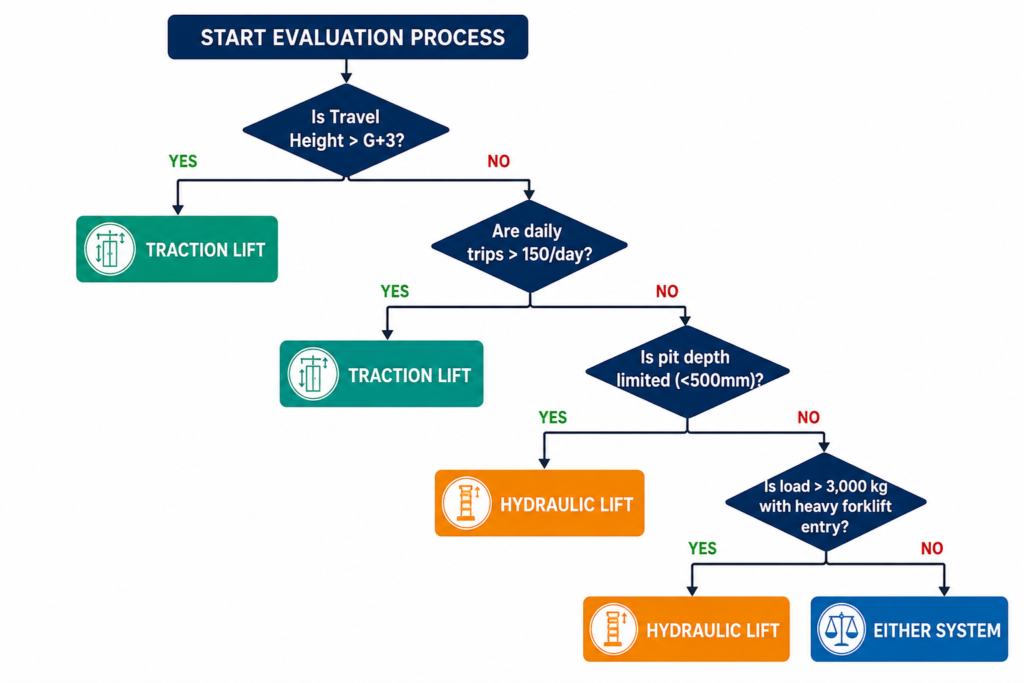
Use this decision matrix to select the ideal elevator architecture for your Pune facility:
Choose a Hydraulic Goods Lift If:
- Your industrial plant or warehouse spans 2 to 4 levels (up to 15 meters travel height).
- You require heavy goods elevator load capacity ranging from 2,000 kg up to 10,000 kg.
- You need to load goods using heavy ride-on forklifts or powered stackers that apply severe point-impact loads.
- Your building site cannot accommodate deep pit digging (pit depth restricted to 300 mm–500 mm) or high overhead clearance.
- You want to lower initial installation and civil modification costs while maintaining a robust factory material transport lift.
Choose a Traction Goods Lift If:
- Your distribution facility spans 5 or more levels (G+4 to G+10+).
- Your operations require continuous, 24/7 high-speed material transfers between floors.
- Your material handling involves lighter, high-frequency loads, such as hand carts, parcel totes, or light pallets.
- Your building design includes a deep concrete pit (1,200 mm+) and standard overhead headroom.
Why Partner with Horizon Elevators for Industrial Mobility in Pune?
Selecting the correct lift mechanical architecture is only half the equation; partnering with an experienced local manufacturer ensures long-term reliability and compliance. Horizon Elevators is a leading provider of custom industrial vertical transportation systems in Pune and across Maharashtra.
Our engineering team works directly with factory managers, structural consultants, and architects to deliver complete end-to-end solutions:
- Custom Engineering: Tailored platform dimensions, heavy-gauge steel cabin wall reinforcement, and specialized loading door setups (collapsible gates, vertical bi-parting doors, or automatic motorized doors).
- Comprehensive Maintenance: Every installation is supported by a customized industrial lift maintenance contract, providing preventive maintenance and 24/7 rapid emergency support across Pune’s industrial corridors.
- Versatile Product Portfolio: Explore our complete range of specialized hydraulic goods lifts and modern machine room-less elevators to find the ideal match for your operational demands.
Transform Your Industrial Logistics Efficiency Today
Don’t let inefficient material handling slow down your production lines or delay warehouse fulfillment. Whether you need a heavy-duty hydraulic freight elevator for a manufacturing plant or a high-speed traction goods lift for a distribution center, Horizon Elevators provides robust, custom-engineered vertical transportation systems built for industrial performance.
Get a customized industrial lift quote or site survey from Horizon Elevators today.
Speak directly with our industrial lift application engineers in Pune to review your building layout, calculate optimal load capacities, and receive a competitive quote tailored to your facility.
Call Us directly: +91 9850004042
Email Our Engineering Team: info@horizonelevators.in
Visit Our Main Hub: 11D, Sai-Samarth Park, Near Navale Bridge, Vadgaon (Bk), Pune – 411051, Maharashtra.
Frequently Asked Questions (FAQs)
Q1: What is the average installation timeframe for a hydraulic goods lift in Pune?
A standard hydraulic goods lift installation takes approximately 3 to 5 weeks after civil shaft preparation and site readiness. Custom high-capacity units (above 5 Tons) may take 6 to 8 weeks, including factory fabrication, precise assembly, and final safety testing.
Q2: Can a hydraulic goods lift operate during power outages?
Yes. Hydraulic goods lifts offer a major advantage during power failures: they can easily integrate an Automatic Rescue Device (ARD) or manual lowering valve. Because descent relies on gravity and oil release rather than heavy motor traction, operators can manually or automatically lower the cabin to the ground floor to unload goods during a blackout.
Q3: What pit depth is required for a 2-Ton hydraulic goods lift?
A standard 2-Ton hydraulic goods lift typically requires a pit depth of just 300 mm to 500 mm. If floor digging is restricted by bedrock or underground utilities, a low-profile ramp can be installed at the ground entrance, eliminating the need for floor excavation.
Q4: How frequently should an industrial goods elevator undergo maintenance?
Industrial goods elevators should be inspected monthly under a comprehensive industrial lift maintenance contract. Monthly checks focus on hydraulic fluid purity, door interlocks, wire rope tensioning, mechanical brakes, and emergency safety devices to ensure full compliance with Maharashtra Lift Rules.
Q5: Can we upgrade an older traction goods lift to a hydraulic system?
Yes, retrofitting is often possible depending on existing shaft dimensions and structural support points. However, since hydraulic systems exert force downward onto the pit floor rather than hanging from top structural overhead beams, a site survey by Horizon Elevators engineers is recommended to assess structural feasibility.