
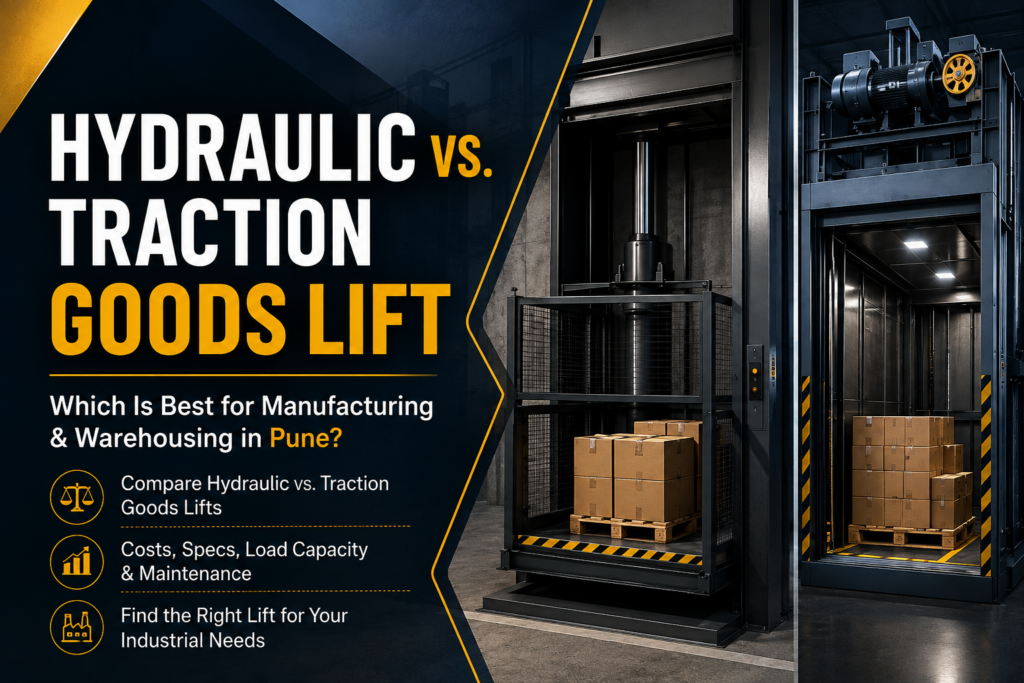
Hydraulic Goods Lift vs. Traction Goods Lift: Which Is Best for Manufacturing & Warehousing in Pune?
Last Updated on August 7, 2026 by Admin Selecting the right industrial vertical transport system is one of the most critical decisions a factory or facility manager will make. In Pune’s rapidly expanding industrial belts—such as Chakan, Bhosari, Talegaon, Hadapsar, and Ranjangaon—smooth material movement directly influences overall operational throughput. When investing in an industrial vertical transport solution, logistics leads and operations supervisors inevitably face a key technical dilemma: Hydraulic Goods Lift vs. Traction Goods Lift: Which Is Best for Manufacturing & Warehousing in Pune? Choosing the correct hydraulic goods lift in pune requires a careful evaluation of structural requirements, operational speed, long-term energy consumption, and load handling requirements. Selecting an mismatched elevator system can lead to severe bottlenecks, frequent downtime, excessive power expenses, and expensive structural alterations. Whether you operate a high-turnover automotive assembly plant in Chakan, an electronics assembly hub in Hinjewadi, or a multi-tier distribution center near the Mumbai-Pune Expressway, understanding the core mechanical differences between hydraulic cylinder mechanisms and electric traction drive systems is essential for maximizing ROI. This detailed engineering and financial comparison breaks down mechanics, installation prerequisites, load capabilities, maintenance profiles, and real-world costs to help you select the ideal vertical transport system for your Pune manufacturing or logistics facility. Understanding the Mechanics: Hydraulic vs. Traction Systems Before evaluating costs and operational parameters, it is helpful to examine how these two distinct engineering systems generate vertical lift movement. How a Hydraulic Goods Lift Works A hydraulic goods lift utilizes a high-pressure hydraulic cylinder lifting mechanism connected to an electrically driven pump unit. To elevate the platform or cabin, an electric motor pumps specialized hydraulic oil from a fluid reservoir into the cylinder. This pressure extends a steel piston, pushing the elevator car upward along guide rails. To lower the car, the system opens an electronically controlled control valve, allowing gravity to gently push the oil back into the reservoir without requiring active motor power. This mechanical layout makes hydraulic systems exceptionally sturdy, physically robust, and capable of handling intense direct impact loads during forklift loading operations. How a Traction Goods Lift Works A traction goods lift relies on electric traction drives. Heavy-duty steel wire ropes or flat polyurethane belts pass over a groove-cut drive sheave connected to an electric motor (geared or gearless permanent magnet synchronous motor). The cabin is suspended on one end of the ropes, while a calculated counterweight balances the load on the opposite side. As the electric motor turns the sheave, friction between the steel cables and the drive sheave pulls the car upward or downward. Because the counterweight offsets approximately 40% to 50% of the maximum cabin weight, traction elevators require less electrical power to move heavy loads continuously over multiple floors. Key Comparison Parameters for Pune Manufacturers and Warehouses To determine whether a hydraulic goods lift or a traction goods lift aligns with your facility, evaluate these critical operational attributes: 1. Travel Height and Floor Level Capabilities If your manufacturing facility or warehouse operates across 2 to 4 levels (Ground + 1 to Ground + 3 floors), a hydraulic system excels. Hydraulic cylinders have practical stroke-length constraints; elevating a car beyond 15 to 18 meters requires multi-stage telescopic rams or indirect chain-guided systems. Conversely, if your logistics hub or high-density storage building spans 5 or more levels (up to G+10), a traction goods lift is the standard choice. Traction systems utilize suspension cables rather than rigid pistons, meaning vertical travel height is limited only by building architecture and steel rope lengths. 2. Lifting Speed and Duty Cycle Demands Speed directly dictates material throughput in high-velocity logistics centers: 3. Load Capacity and Structural Floor Rigidity When transferring heavy pallets using electric stackers, hand pallet trucks, or heavy-duty forklifts, the elevator car experiences sudden, severe point-impact stresses during loading: Technical Specifications Comparison When drafting engineering proposals or reviewing warehouse goods elevator specifications, consult this detailed technical baseline: Specification Attribute Hydraulic Goods Lift Standard Traction Goods Lift Standard Goods Elevator Load Capacity 500 kg up to 10,000 kg (10 Tons) 500 kg up to 5,000 kg (5 Tons) Motor Drive Type Submerged Hydraulic Pump / Power Pack Geared Traction / Gearless MRL Drive Pit Depth Requirement Shallow Pit (300 mm to 600 mm) Deep Pit (1200 mm to 1800 mm) Overhead Headroom Clear Low Clearance (3200 mm to 3600 mm) Standard Clear (4200 mm to 4800 mm) Machine Room Requirement Optional / Side Machine Unit Top Machine Room or MRL Shaft Side Power Consumption Profile Power used ONLY during ascent Power used during ascent & descent Safety System Features Rupture Valve, Manual Drop Valve Speed Governor, Safety Clamps Civil Works, Spatial Efficiency, and Installation Logistics For industrial companies in Pune looking to retrofit an elevator into an existing structure, civil alteration costs can rival the purchase price of the lift itself. Pit Depth and Overhead Space Constraints Machine Room Flexibility Hydraulic systems offer significant installation flexibility. The hydraulic power pack and control panel do not need to be situated directly above or adjacent to the shaft. They can be placed in a compact enclosure up to 10–15 meters away from the lift shaft. Traction systems traditionally require a dedicated structural machine room directly above the hoistway. Modern machine room-less goods lift (MRL) traction designs eliminate this top room by mounting a compact gearless motor inside the shaft headroom, though this setup still demands higher vertical clearance than a standard hydraulic unit. For further regulatory guidance on civil structure safety, refer to official Indian standards published by the Bureau of Indian Standards (BIS) covering code of practice for installation and maintenance of goods lifts. Cost Analysis: Capital Expenditure vs. Operational Expenditure Evaluating the overall financial commitment requires balancing initial machinery procurement costs against long-term maintenance, electricity consumption, and facility structural alterations. Initial Capital Cost (CapEx) Breakdown When evaluating total industrial material handling lift cost, hydraulic systems generally offer a lower initial purchase price for low-rise applications (up to G+3). The mechanical design involves fewer moving parts, eliminates heavy cast-iron counterweights, and avoids