
Last Updated on April 23, 2026 by Admin
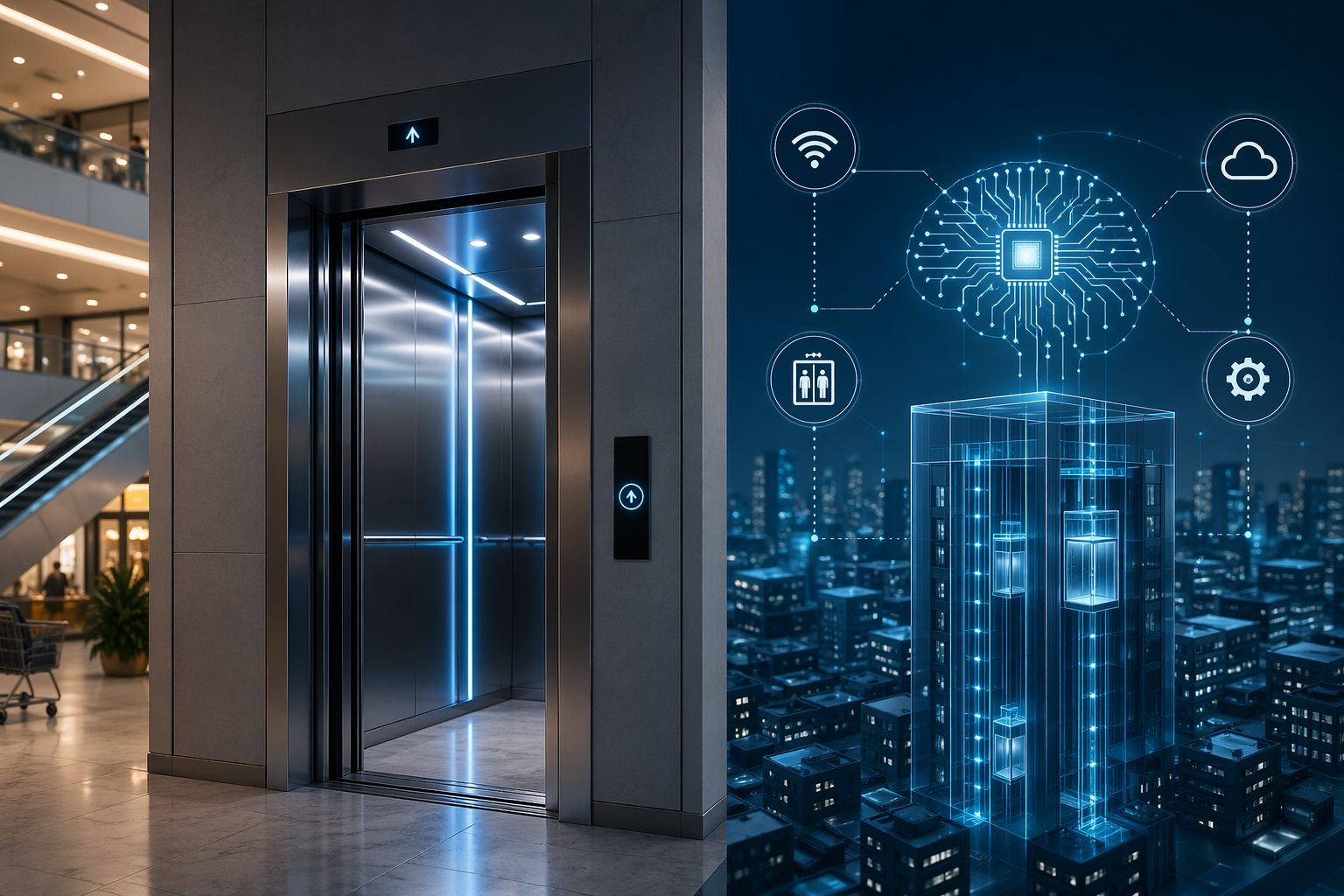
The skyline of urban India is reaching unprecedented heights, and with it, the way we navigate these vertical landscapes is undergoing a radical transformation. Gone are the days when an elevator was merely a metallic box controlled by physical buttons and cables. As we move through 2026, the concept of Smart Elevators in India: How AI & IoT Are Transforming Lift Technology in 2026 has shifted from a futuristic luxury to a fundamental necessity for modern infrastructure.
With the rapid integration of Artificial Intelligence (AI) and the Internet of Things (IoT), elevators are evolving into “thinking” machines that prioritize passenger safety, efficiency, and comfort. Companies like Horizon Elevators are at the forefront of this digital revolution, ensuring that residential and commercial buildings across India benefit from enhanced safety, zero downtime, and unmatched energy efficiency. This article explores the deep impact of these technologies on the industry and what the future holds for vertical transportation in the subcontinent.
The Dawn of Intelligence: What Defines a Smart Elevator in 2026?
In 2026, a “smart elevator” is no longer defined just by its speed or aesthetic appeal. It is defined by its ability to interact with its environment and learn from the data it generates. Unlike traditional traction systems, these modern lifts use a complex network of high-fidelity sensors and data analytics to optimize performance in real-time.
1. AI-Driven Maintenance Prediction
One of the most significant shifts in Smart Elevators in India: How AI & IoT Are Transforming Lift Technology in 2026 is the move from reactive to proactive care. Historically, elevator maintenance was scheduled based on time or after a failure occurred. Today, AI algorithms monitor every vibration, door cycle, and motor temperature.
Instead of waiting for a breakdown, the system utilizes maintenance prediction to identify potential failures before they occur. This ensures that residents are never stranded, a core value provided by Horizon Elevators’ about us page. By analyzing historical data and current performance metrics, the AI can alert technicians to replace a component just before it reaches its wear limit, maximizing uptime and safety.
2. IoT-Enabled Real-Time Monitoring
The Internet of Things (IoT) acts as the nervous system of the lift. By connecting elevators to a centralized cloud platform, building managers can monitor the health of multiple units from a single mobile dashboard. This level of connectivity allows for remote diagnostics, where software glitches can often be resolved without a technician even stepping on-site. In a country as vast as India, this remote capability is crucial for maintaining operational efficiency in tier-2 and tier-3 cities.
Strategic Comparison: Traditional vs. Smart Elevators (2026 Standards)
To understand why the shift toward Smart Elevators in India: How AI & IoT Are Transforming Lift Technology in 2026 is so aggressive, we must look at the technical differences:
| Feature | Traditional Elevators | Smart AI-IoT Elevators (2026) |
| Maintenance | Scheduled/Reactive | Predictive & Proactive |
| Control System | Relay or Basic Microprocessor | AI-Neural Networks & Cloud Sync |
| User Interface | Physical Push Buttons | Voice, Gesture & Mobile App |
| Energy Usage | Constant (High Consumption) | Regenerative (40% Energy Recovery) |
| Wait Times | High (First-come, first-served) | Optimized via Destination Control |
| Security | Manual Key/CCTV | Facial Recognition & Biometrics |
Key Trends Shaping India’s High-Rise Infrastructure in 2026
The Indian market presents unique challenges—high-density populations, varying power quality, and intense climatic conditions. Here is how technology is adapting to meet these needs:
Destination Control Systems (DCS)
In high-traffic hubs like Mumbai, Pune, and Bangalore, “Destination Control” has become a game-changer. Instead of the traditional ‘up’ or ‘down’ buttons, passengers select their specific floor on a touch-panel in the lobby. The AI then groups passengers traveling to the same floor into the same car. This reduces “ghost calls” and cuts down wait times by up to 30%, which is vital for high-rise infrastructure during peak office hours.
Touchless Lift Controls and Gesture Recognition
Post-pandemic hygiene awareness has made touchless lift controls a permanent fixture in premium developments. Modern lifts now feature gesture-based sensors or voice-activated commands. Imagine entering a lift and simply saying, “Floor 12,” or using a mobile app to call the elevator before you even leave your apartment. This technology not only improves hygiene but also enhances accessibility for differently-abled individuals.
Sustainable Urban Development and Energy Efficiency
As India pushes toward sustainable urban development, elevators must contribute to the green building movement. Smart elevators in 2026 utilize regenerative drives that capture the energy generated during braking and feed it back into the building’s power grid. This reduces overall energy consumption by up to 40%. According toWikipedia’s entry on Elevator Technology, this technology is a cornerstone of modern eco-friendly design, turning every descent into a power-generating event.
City-Specific Impact: How Indian Metros are Adapting
The rollout of Smart Elevators in India: How AI & IoT Are Transforming Lift Technology in 2026 varies across the country based on local architectural demands:
Mumbai and the Vertical Expansion
In Mumbai, where space is at an absolute premium, developers are utilizing Machine-Room-Less (MRL) technology. AI helps manage the extreme traffic of 60+ story residential towers, ensuring that even during rush hour, the “elevator wait anxiety” is minimized through predictive dispatching.
Bangalore and the Tech-Integration
As the Silicon Valley of India, Bangalore’s corporate parks are integrating elevators directly into the building’s IT ecosystem. Lifts are now synced with employee ID badges; when an employee swipes into the building, the elevator is automatically called and pre-programmed for their specific office floor.
Pune’s Industrial and Residential Growth
In Pune, the demand for industrial goods lifts is skyrocketing. Here, IoT sensors are used to ensure that heavy machinery is transported without putting undue stress on the lift motor, extending the equipment’s lifespan by years.
Why Horizon Elevators is the Leader in Smart Lift Solutions
When it comes to implementing Smart Elevators in India: How AI & IoT Are Transforming Lift Technology in 2026, Horizon Elevators stands out as a pioneer. Their commitment to merging German engineering principles with Indian requirements ensures that your building is future-proof.
Customization for Diverse Sectors
Whether you require a hospital/stretcher lift with precision floor-leveling for patient safety or a luxury home elevator with AI-integrated security, Horizon Elevators provides tailored solutions. They specialize in:
- Residential Smart Lifts: Seamlessly integrating with home automation systems like Alexa or Google Home.
- Industrial Goods Lifts: Using IoT sensors to track heavy-load performance and prevent motor strain.
- Modernization Services: Upgrading legacy lifts with the latest AI-enabled controllers and touchless interfaces without the need for a full replacement.
Machine-Room-Less (MRL) Elevators: Space for Innovation
A key advancement is the widespread adoption of Machine-Room-Less (MRL) elevators. By eliminating the need for a bulky overhead machine room, developers can utilize that space for penthouses or rooftop gardens. Horizon Elevators’ MRL designs are integrated with smart sensors that monitor the motor’s health even in tight, enclosed spaces, ensuring safety is never compromised for aesthetics.
The Role of AI in Passenger Safety and Emergency Response
Safety is the paramount concern in any vertical transportation system. In 2026, AI goes beyond simple obstacle detection.
- Intelligent Emergency Response: If the AI detects an unusual pattern—such as a passenger fainting or a door obstruction—it can automatically trigger an emergency descent to the ground floor and alert the 24/7 support team at Horizon Elevators.
- Automated Rescue Devices (ARD): While ARDs have existed for years, the 2026 version is “Smart.” It calculates the weight in the car and the battery level to choose the most energy-efficient floor for a safe exit during a power cut.
- Biometric Access: Smart elevators now use facial recognition to restrict access to specific floors, enhancing the security of gated communities and corporate headquarters.
The integration of these technologies makes Indian cities safer and more efficient. As noted by industry experts at Day Elevator, the design trends of 2026 emphasize a balance between transparent glass designs and “invisible” smart technology that works in the background.
Data-Driven Decision Making for Building Managers
The 2026 smart elevator acts as a data hub. It provides building managers with detailed analytics on:
- Traffic Patterns: Which floors are most active at what time? This helps in optimizing lighting and HVAC systems on those floors.
- Energy Consumption Reports: Detailed logs of how much power the lifts are using, helping buildings achieve LEED certifications.
- Maintenance Logs: A transparent, digital history of every service call and part replacement, ensuring accountability.
This level of transparency is exactly what modern real estate developers in India need to maintain high property values and tenant satisfaction.
Enhancing the User Experience: The “Inside-the-Car” Revolution
In 2026, the interior of a smart elevator is a digital sanctuary.
- Smart Mirrors: Displays integrated into mirrors show news updates, weather, and building announcements.
- Atmospheric Lighting: AI adjusts the cabin lighting based on the time of day or the number of passengers, creating a calming environment during a stressful workday.
- High-Speed Connectivity: Guaranteed 5G/6G signal boosters inside the car ensure that your video call doesn’t drop between the 1st and 40th floor.
The Synergy of AI and Green Building Standards
India’s commitment to net-zero emissions by 2070 has forced the construction industry to rethink every component. Smart elevators are crucial for achieving Indian Green Building Council (IGBC) ratings. By using standby modes (where the lift “sleeps” when not in use) and LED-based sensor lighting, these lifts consume minimal power. Furthermore, the data collected by IoT sensors allows for “load balancing” across multiple lifts, ensuring no single unit is overworked, thereby reducing the carbon footprint of the building’s entire vertical transport system.
Choosing the Right Partner for the Future
Transitioning to a smart elevator system requires more than just purchasing hardware; it requires a partnership with a company that understands the digital landscape and the nuances of Indian electricity and weather conditions. Horizon Elevators provides a comprehensive journey from the initial architectural consultation to AI-integrated installation.
Our Service Commitment:
- Expert Consultation: Assessing your building’s traffic flow using AI-driven simulation software.
- Precision Installation: Certified technicians ensuring every IoT sensor and cloud-node is perfectly calibrated.
- Comprehensive AMC: Annual Maintenance Contracts that include 24/7 remote monitoring and guaranteed response times.
Are you ready to upgrade your building to the 2026 standard of vertical mobility? Don’t let your infrastructure become a bottleneck for your building’s growth. At Horizon Elevators, we combine the reliability of traditional engineering with the brilliance of AI and IoT. Whether you are a developer looking for the next-gen commercial solution or a homeowner seeking a sophisticated personal lift, we have the expertise to elevate your experience.
Contact Horizon ElevatorsToday for a Free Quote and Smart Tech Audit!
Frequently Asked Questions (Q&A)
Q1: How do AI elevators improve safety in Indian conditions?
AI elevators use real-time sensors to detect anomalies such as voltage fluctuations (common in India) or motor vibration. They can predict mechanical issues before they happen and automatically initiate emergency protocols, such as stopping at the nearest floor if a fault is detected, far more reliably than manual systems.
Q2: What is the benefit of IoT for a building manager?
IoT allows elevators to “communicate” with a central monitoring station. This enables building managers to see the status of all lifts in real-time on their phones and allows technicians to perform remote diagnostics, which drastically reduces the time a lift is out of service.
Q3: Are smart elevators more energy-efficient?
Yes. Through regenerative drives and AI-optimized traffic management (Destination Control), smart elevators reduce unnecessary trips and recycle energy during descent, lowering the building’s overall electricity bill by a significant margin.
Q4: Can my existing old elevator be modernized with AI?
Absolutely. Horizon Elevators specializes in modernization kits. We can replace your old controllers with AI-enabled units and add IoT sensors and touchless panels to your existing lift structure, giving you 2026 technology without the cost of a full new installation.
Q5: What happens during a power failure in a smart elevator?
Smart elevators are equipped with Advanced Automated Rescue Devices (ARD) and dedicated battery backups. The AI ensures the lift moves to the nearest floor using the least amount of energy and opens the doors safely before shutting down non-essential systems.
Q6: Is my data safe with an IoT-connected elevator?
Horizon Elevators uses end-to-end encryption for all data transmitted between the lift and the cloud. The data collected is used solely for performance monitoring and maintenance prediction, ensuring resident privacy is maintained.
Q7: How does “Destination Control” actually work? I
nstead of hitting a button inside the car, you select your floor on a kiosk in the lobby. The system tells you which car (A, B, or C) to enter. This ensures the lift doesn’t stop at every floor, making the journey much faster and saving energy.
Q8: Do smart elevators require more frequent maintenance?
Actually, they require less frequent manual inspections. Because the AI is constantly monitoring the system, technicians only need to visit when the data indicates a part is nearing its end-of-life, saving you money on unnecessary service calls.